You are currently viewing content for the location:

International / English

Please select your region/language

You are currently in International

International
Close country selector banner

What’s the difference between the charging types AC, DC, and HPC?

Table of Contents

  1. Applicable models
  2. The basics of Alternating Current (AC) and Direct Current (DC) 
  3. What role does charging power play and what does kW mean? 
  4. What defines AC charging and when should I use it?
  5. What defines DC and HPC charging and when should I use it?
  6. Which port and plug types are used for AC or DC charging?
  7. Where can I find the charging ports on my Porsche? 
  8. What is a Mode 3 charging cable? 

Electric cars can be charged using two types of power – Alternating Current (AC) and Direct Current (DC). Both methods do the same thing – charging your car – but they differ in how they work and the speeds they offer: 

AC stands for Alternating Current, which refers to charging with alternating current. This method is ideal for regular charging. It’s usually slower and is perfect for home charging or for charging when you’re parking for a long time. DC stands for Direct Current, which means charging with direct current. It’s designed for fast charging on the go. It’s only available for BEVs. HPC – which stands for High-Power Charging – is part of DC technology and provides exceptionally high charging speeds. 

Learn more about the physical basics, the differences and unique features of the charging methods – as well as information about charging plugs and cables – in this article. 

Applicable models

All BEVs & PHEVs 

The basics of Alternating Current (AC) and Direct Current (DC) 

The electricity that comes from a household socket is AC because its strength and direction change in a regular rhythm. Our entire electricity power grid is based on AC since it allows voltage to be easily transformed up or down for efficient transport with minimal losses.

However, when charging an electric car, there’s a challenge – the battery can only store DC power, where the current flows in one constant direction. This is why AC power from the grid must be converted into DC before it reaches the battery.


What role does charging power play and what does kW mean? 

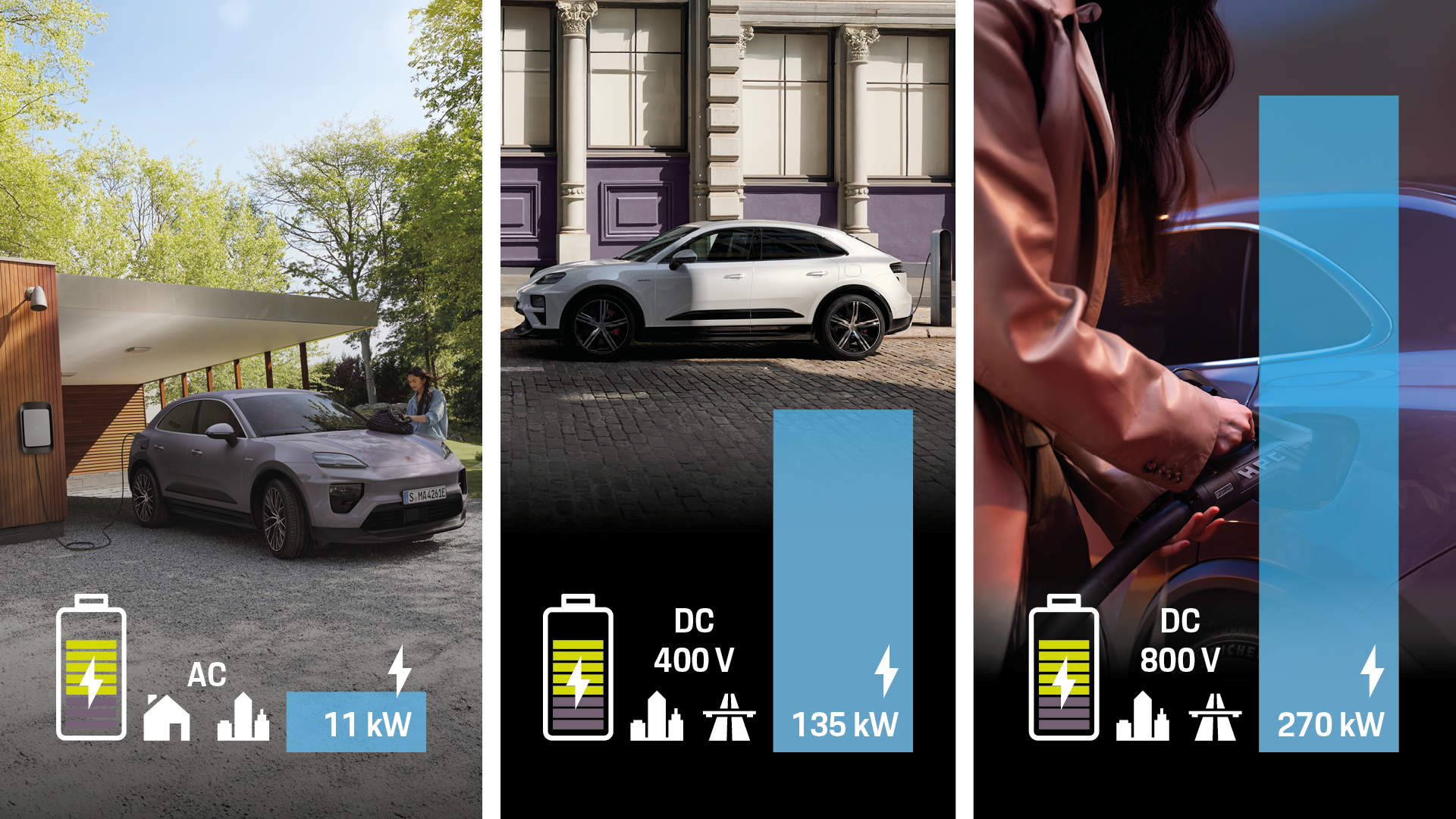
Charging power is measured in kilowatts (kW). Put simply, the higher the kW value, the faster your car’s charging process – think of it as being similar to how the more litres per minute a fuel pump can produce can help speed up the refuelling process.  


EV charging comparison: Porsche electric car charging at home AC 11 kW, public DC 400V 135 kW, and ultra-fast DC 800V 270 kW charging stations. Electric vehicle fast charging efficiency for urban and highway use.

Good to know? The weakest link determines the charging power. This means that charging power and time are always limited by the weakest component – be it the car, the cable you use, the charging station or the grid connection. For example, if the charging station only supplies 150 kW, the charging power is limited to that – even if the car supports higher speeds. 


What defines AC charging and when should I use it?

The main difference between AC and DC charging is where the alternating current (from the power grid) is converted into direct current (for charging the battery). With AC charging, this conversion happens inside the car. Electric cars have a built-in converter, known as an On-Board Charger (OBC), which takes the alternating current and converts it into direct current through several stages. This process results in a longer charging time, which is why AC charging is ideal for regular charging at home or at work, overnight, or during long‑duration parking. With AC charging, the maximum power you can achieve is up to 22 kW. In contrast, DC (or HPC) charging can deliver up to 400 kW.  

At home, AC charging is typically used, for example with the Porsche Wallbox. While the charging power is much lower compared to a DC or HPC station, this usually doesn’t make a big difference for everyday use. 

What defines DC and HPC charging and when should I use it?

DC is the foundation for fast charging when using public charging infrastructure. When charging at a DC or HPC station, the On-Board Charger (OBC) is bypassed because the conversion from AC to DC happens directly inside the charging station. DC charging is ideal whenever you want to charge your car quickly, for example during a longer trip or when taking a break on the motorway. It can also be a convenient option during everyday routines, such as shopping, grabbing a coffee, or running quick errands, as it can give your car a fast boost even during short stops. Standard DC chargers can deliver up to 400 kW of power. Any charging power above 50 kW is considered ‘fast charging’. HPC is a particularly fast form of DC charging, delivering more than 150 kW of power.

The Cayenne Electric sets new benchmarks in fast charging with approximately 16 minutes charging time (Charging time for direct current (DC) with maximum charging output from 10% SoC to up to 80% SoC under optimal conditions (CCS fast charging pedestal with > 390 kW, > 850 V, > 520 A, battery temperature 15 °C and initial SoC 9%)).
Which port and plug types are used for AC or DC charging?

Note: The following information applies to European standards.

To charge at your home wallbox, you’ll usually need a Type 2 plug. Public AC charging stations also use this connector. For fast DC charging, a CCS plug (Combined Charging System) is required.

Every Porsche BEV comes equipped with the CCS (Combined Charging System) port – a single connector designed for convenient AC and DC charging. In addition, each Porsche BEV also features a dedicated AC port for Type 2 plugs.

Since PHEVs can only be charged with alternating current, the corresponding Porsche cars are equipped with an AC port for Type 2 plugs.

Where can I find the charging ports on my Porsche? 

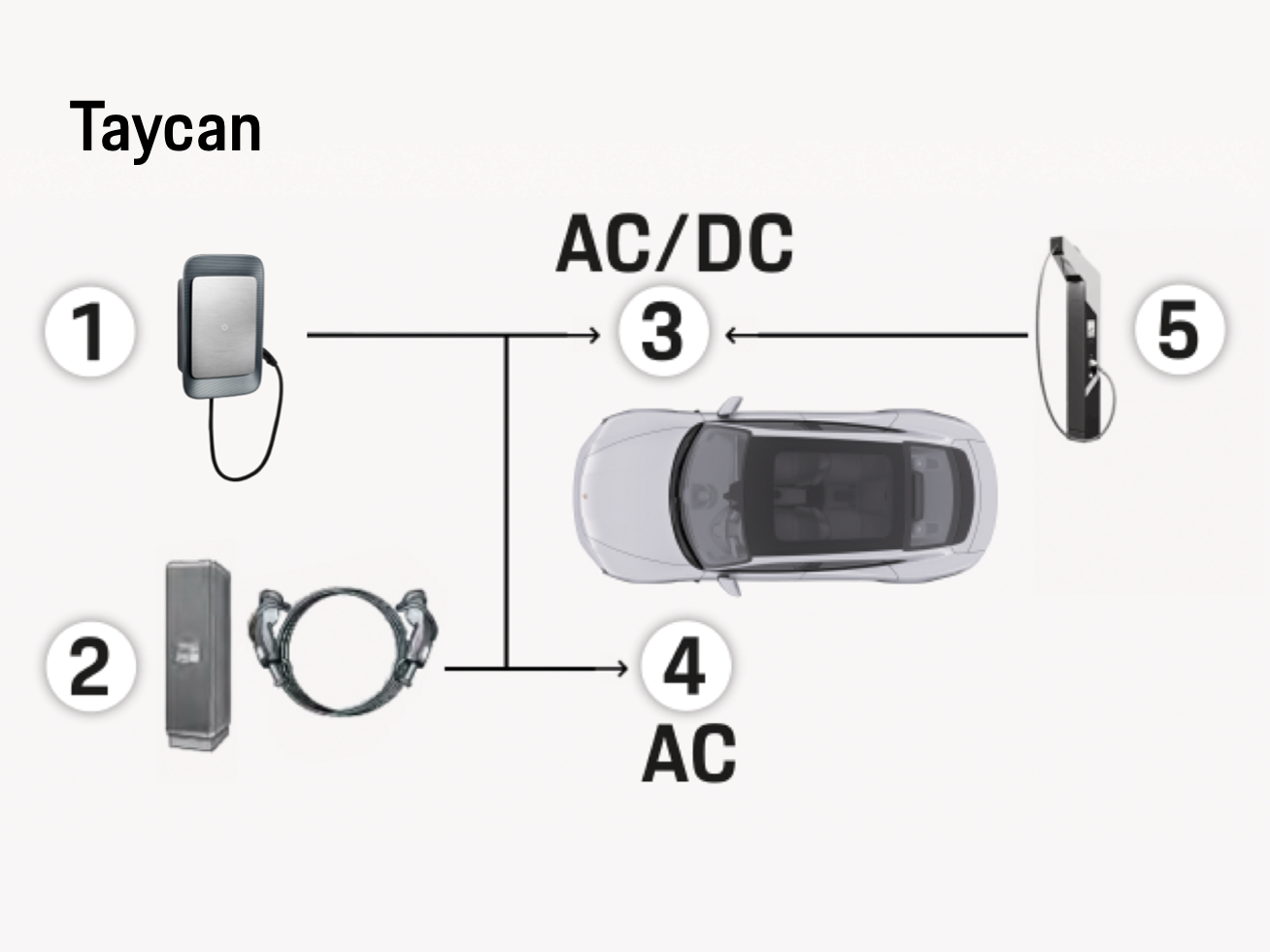
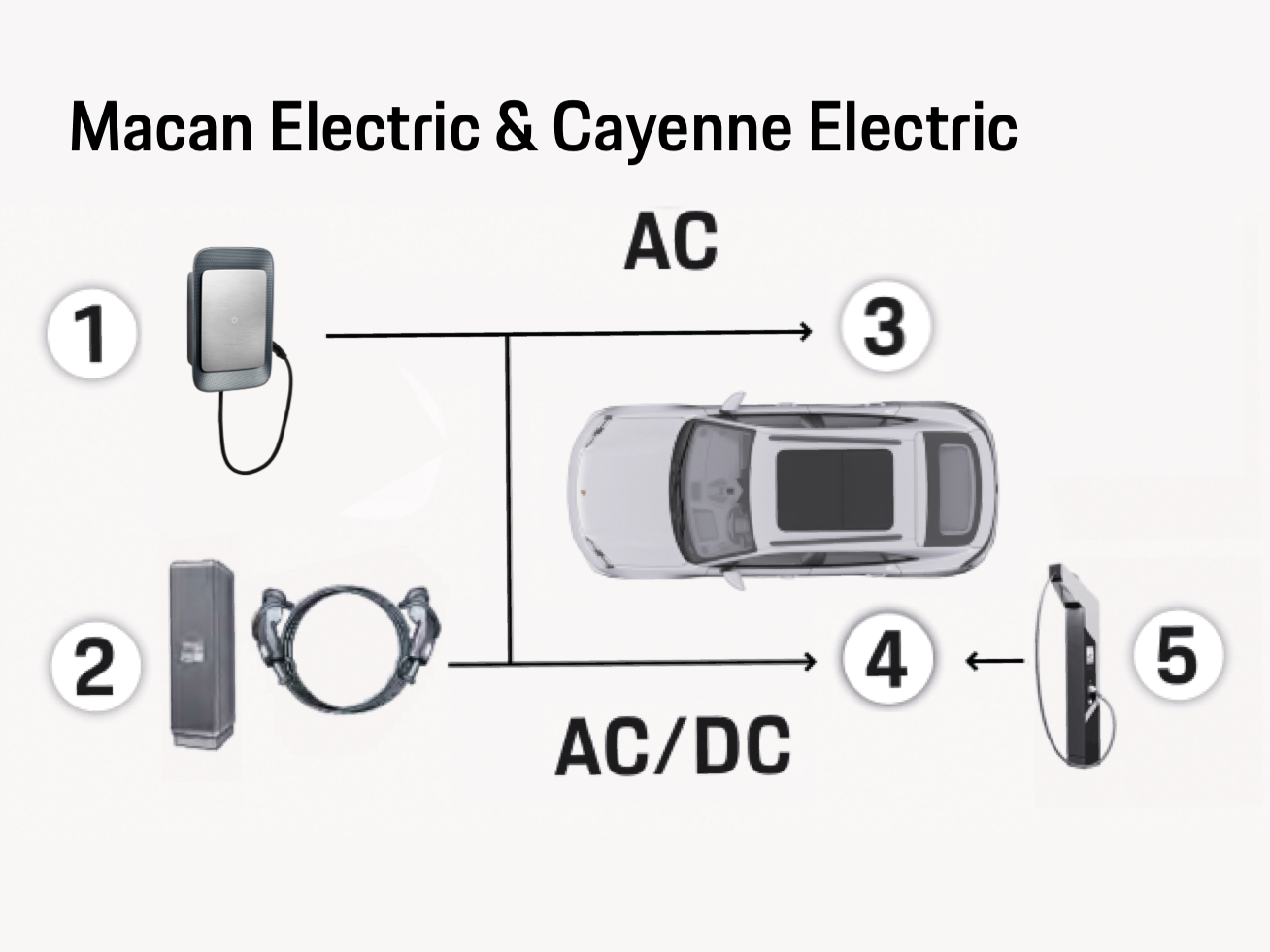
The charging port position depends on whether you use AC or DC charging. These illustrations are showing for the Macan Electric, Cayenne Electric and Taycan where the charging ports are located. Please refer to your car’s Owner’s Manual to check if there are more specific details for your model. 

Illustration showing for the Macan Electric and Cayenne Electric where the charging ports are located.

1) Charging equipment with AC, 2) Charging station with AC, 3) Charge port driver’s side (right-hand drive) or passenger side (left-hand drive), 4)Charge port driver's side (left-hand drive) or passenger side (right-hand drive), 5)Charging station with DC

Illustration showing for the Taycan Electric where the charging ports are located.

1) Charging equipment with AC, 2) Charging station with AC, 3) Charge port driver’s side (right-hand drive) or passenger side (left-hand drive), 4)Charge port driver's side (left-hand drive) or passenger side (right-hand drive), 5)Charging station with DC

What is a Mode 3 charging cable? 

The Mode 3 cable is the European standard for AC charging – it’s required, for example, at public AC stations with Type 2 connectors in urban areas. 

The Mode 3 cable is part of the standard equipment for a Porsche BEV or PHEV and should always be carried in your car, as many AC public charging stations do not provide their own cable. 

You can find more information about Porsche charging equipment at the Porsche Shop


Premium Porsche EV charging cable with black storage case, Type 2 connector for home and public electric car charging. High-quality portable charging solution for luxury electric vehicles and sustainable mobility.

Some of the described products, features, and processes may vary depending on the country, model, and model year.